
Street Address
City, State, Zip
Phone Number
valve amplfiier specialist custom design of amps & studio gear
Your Custom Text Here
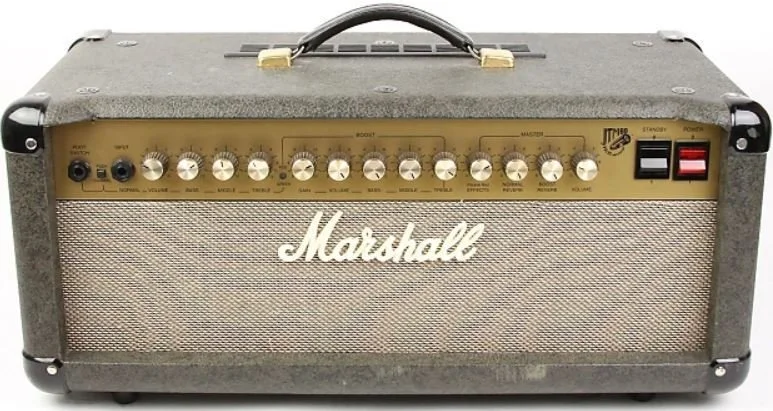
Not the actual amp
JTM60 MARSHALL HEAD
DIAGNOSIS
Fault A) : Catastrophic power tube failure due to thermal runaway
The two power tubes got overheated and in one of them the extreme high temperature caused part of its anode plate and the glass envelope adjacent to it to melt. Fortunately the high voltage (HT) fuse blew in time and no further damage was done to other components.
This type of fault can be caused by a range (and often a combination ) of underlying issues :
1a) Complete loss of the negative bias voltage at the control grid of the output tubes, pointing to faults in the biasing section that controls the current flowing to the power tubes see (e).
b) The output tubes are running too hot because they are wrongly biased and as a result they draw high amounts of current when the amp idles; this often leads to positive bias drift. What happens is that the biasing voltage drifts to a more positive value incrementally, ( i.e. a gradual bias drift) causing the tube(s) to conduct even more current. This higher current raises the temperature further creating more bias drift (a knock on effect) until one or both of the output tubes enter a state of thermal runaway. This leads to over dissipation where the anode plate temperature can reach such a high value so that a small area of it (i.e. a spot) melts and often causes part of the glass envelope to melt too. Often the fuse does not blow quickly enough due to the fact that this is a gradual overload and consequently other components like the power and the output transformers can burn internally due to overheating, if the amp is not switched off immediately.
c) Bias drift can also (and often most likely in old aging tubes) be a defect of a particular tube itself that has developed over time and not necessarily related to the original biasing adjustment or the biasing circuit.
d) A high operating voltage see 2.
e) A faulty or poorly designed biasing circuit and unfortunately the JTM60 biasing circuit has a relatively high internal resistance; that may not necessarily be a design fault here though because the EL34 maximum control grid resistance rating is high (0.5M). However, high resistance biasing circuits are less stable and that can become a problem in the JTM60, due its high operating voltage (see 2). The biasing circuit in this amp was checked and it is working.
2) The output stage operates at a higher than the usual 460-470Vdc voltage (HT) on the anode plates and screens of the two EL34 tubes. The JTM60 operates at 500Vdc, this is why the JTM60 is more powerful (60w) than most 2xEL34 guitar amps ( 50w output). This feature unfortunately comes at the cost of poor reliability, low output tube longevity and makes the amp susceptible to catastrophic faults.
If the AC mains voltage increases to 245V AC, the HT will go up to 510Vdc; the mains voltage in the UK often reaches 245V AC while in some rural areas can sometimes go as high as 250V AC. The EL34 anode plate can handle up to 800Vdc but the screen terminal has an absolute maximum voltage rating of 450Vdc. This high screen voltage (above the maximum limit) can cause catastrophic tube failures due to prolonged arcing and high current surges that cause knock- on effects which can destroy expensive components, like power and output transformers, if the fuse is not blown in time.
These kinds of faults are more likely to happen if the amp is played loud or pushed into 'break up'. Even in amps where the output tubes are properly biased, particularly during a high AC mains supply period, which is not uncommon for it to last more than a few minutes. Using a power attenuator with these amps can create serious damage too, because the player is often not aware how hard the output stage is being pushed into overload.
Alternatively (and many times), this kind of internal arcing followed by a high current surge can occur as soon as the amps HT is switched on (from Stand-By), and therefore before it is even played due to the fact that during this very short switch-on period, i.e. when the HT (SB-Y) switch is pressed and the high voltage (HT) is at its highest ; especially if at that moment the mains AC voltage happens be high as well.
Most possible cause of the fault : The fact that the fuse blew quickly indicates to me that the tube failure was more likely due to high voltage arcing that caused a fast high current surge to flow through the tube(s) and pushed at least one of them into thermal runaway.
Fault B) : Another issue, completely unrelated to fault A is in the preamp section; one of the small 12AX7 tubes has lost most of its emission, as a result it produces very low gain (it has gone down by nearly 50%) and it has also become very noisy. The other three are also low on emission (20% loss or so), but they are still usable. Nevertheless they must be replaced in the near distant future. A failed preamp tube will not cause any knock on effects and catastrophic faults, and can be replaced without any adjustments.
REPAIR
1) Obviously the 2xEL34 tubes must be replaced and the amp re-biased and tested. Charges also include: tests, test reports EL34 replacement, re-bias and after bias soak tests. This repair may last if the amp is used carefully but it is impossible to give any guarantees and as I already explained mains line voltage variations play a role too when it comes to the reliability of this repair.
Important note: Each time power tubes are replaced in adjustable fixed bias amps , such as the JTM60 the bias must be checked and re-adjusted if necessary.
Due to the high operating voltage the EL34s must be biased on the cold side, around 20-25mA /tube.
2) The newly replaced JJ EL34's that the amp came with : These are new, good quality tubes but they are grossly miss matched, that means that for a given negative bias voltage one draws far less idling current than the other and that also applies during the signal excursions.
As a result: a) there will be some signal distortion and the cold biasing effect will have a detrimental effect on this distortion. Now, to what extent this will reflect the tone is a subjective matter: it may be noticeable as loss of sound transparency to some people, others may tolerate it or even like it.
b) A more important problem though is that one of the tubes will supply more of the signal than the other and at such a high operating voltage this miss-match could lead to its over dissipation with all the catastrophic consequences. In fact a mismatch may have contributed to the original fault because as (originally matched as a pair) tubes age, their matching degrades too. see fault A1b.
For reasons I explained this is not a reliable amp especially if it is played loud. Perhaps it will be less prone to damage if pushing it into any kind of break up is avoided.
Reliability improvement options
The most reliable repair is the most expensive option, and that is to: Replace the power transformer with one that supplies a lower HT voltage, similar to other 50w (not 60w) Marshalls. Cost would be extra for the transformer and also for fitting it because the new transformer will be of a different shape and size than the original and space restrictions plus chassis shape make replacement labour intensive. Improve the biasing circuit, this is an easy but necessary job.
The second method is a mod that costs less because it does not involve power transformer replacement. The EL34 screen supply voltage can be reduced, preferably down to 400Vdc. This involves building an extra high voltage power supply. I have done this mod a few times in amps with high HT voltages (including the JTM60) , and it always worked with no reliability issues.
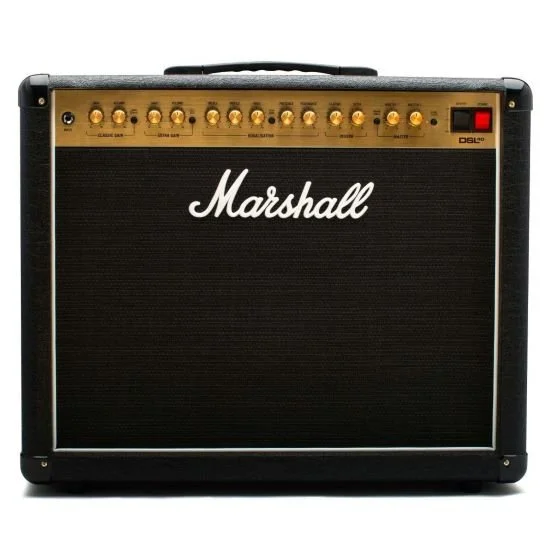
Not the actual amp
MARSHALL DSL40
DIAGNOSIS
The main fault was in the solid state section, specifically the low (+/- 15V) power supply. One of the 1N5353B Zener diodes had failed in short circuit mode so the -15V line was missing, hence the extreme distortion in the signal. The resistor feeding this diode looked overheated so I also replaced it, including the other 1N5353B diode in the +15V line because it tends to fail too.
The printed circuit boards (PCBs) in these amps are prone to dry joints, PCB trace and material erosion due to the heat that various large resistors and medium power Zener diodes generate over the years. The solid state section components always get hot regardless of whether you play the amp loud or not, even if the amp is left on idling or just on stand-by. Therefore it is a good idea to switch the amp off when you are not using it.
REPAIR
I had to do some reconstruction work, removing old solder, and resolder. Some joints needed to be hardwired because the PCB traces where the In5353B diodes were soldered were very thin, poor quality and just about to come off the PCB. Most of the tube socket terminals joints were also dry so I also removed the old solder and resoldered them, the PCB traces around the sockets are still in good condition though.
In the high voltage power supply section the 100uF/450V reservoir capacitor looked as if it had been overheated, it was only 85 Deg. rated so I replaced it with a 105Deg. of the same value. I cleaned all potentiometers (especially the volume pot) with De-oxit because a couple of them were crackling a bit. The small tubes work I test gain and noise. These tubes can go on for years and they are easy to replace.
Design issues with this amp and suggestions on mods in order to avoid future problems
The EL84 power tube bias resistors : The master volume control is a dual potentiometer type and each part serves as a common bias control resistor for each EL84 pair. This is a reliability issue because a potentiometer is an electromechanical component and if it gets either physically damaged or just too dirty and its wiper loses contact even for a short period of time, the bias voltage will disappear and the power tubes will run into thermal runaway (red plating). This could also cause further damage to other components. The volume pot is currently functional but is subjected to wear and tear, so please treat it with care. If it gets physically knocked please don't switch on the amp.
Another potential future problem is the high value of grid resistance when the volume pot is at (or near the) maximum level which is 200k per EL84 pair and that is 400k per single EL84. The EL84 data suggest an absolute maximum of 300k per single EL84. The high operating voltage that the power tubes are operating on must be taken seriously. A solution will be to wire an extra resistor between each EL84 (pair) control grids (two in total) and the bias voltage trimmer. These two resistors then will act as safety grid bias leak resistors for each pair in case the pot gets faulty for whatever reason. The resistors that feed the signal to the volume control will have to be reduced in value too. The only drawback of this mod is that the master volume settings will be affected, but only slightly. There will not be any change in the tone (or power), you may just have to increase the volume just a tiny bit more than where it used to be set before.
The EL84 power tubes in this amp are operating on 410 Vdc, a voltage far too high, the maximum operating voltage given in the data by the manufacturers is 300 Vdc on both screen and anode plate. Such high voltage (above the maximum limit) can cause catastrophic tube failures due to prolonged arcing that can destroy other expensive components like power and output transformers in amps, especially if they are played loud for a long period of time.
This kind of knock on effect faults can occur in new (and old) power tubes during the burn in period, even though the original ones lasted for years under the same high voltage conditions. This is due to the fact that unlike with solid state components (transistors) which fail as soon as the maximum ratings are exceeded, tubes fail on a statistical basis; this is why the maximum ratings must be taken into account in the design process.
Many designers believe that by keeping plate and screen power dissipation in output tubes below the maximum permissible level in class B amps (such as the DSL40) such failures are avoided; they do this by reducing the biasing current i.e. the (no signal) 'standing' current that the output tubes idle. However this is not good enough as a precaution because it does not take into account how loud and close to the 'break up' point the amp is going to be played. Overloading a tube amp in order to create the well sought out 'break up tone' can make it exceed the tube dissipation levels. This is because in class B amps (such as the DSL40) power dissipation’s are directly related to high output signals fed to the guitar amp loudspeaker, especially when tubes are running high on temperature too, for a long period in gigs and rehearsals.
If the output tubes need to be replaced, one solution would be to use military EL84 versions such as the E84L or the 7189 (they claim a maximum 450Vdc), but even they must be used with caution. This is because unlike the larger EL34 or 6L6 types these military EL84 versions are smaller in size and the internal distances between the terminals are shorter than the bigger EL34/6L6 etc types and high voltage arcing is directly related to distance.
If you are using the amp at low volumes, it is very easy to half the power down to 20w by only using one pair and driving the existing 16 Ohms speaker from the 8 Ohms output, there is a switch in the rear panel to do that, this is a common mod. We can then only replace one pair of EL84s with the military E84L type from Watford Valves which are burst tested. I tested the power tubes on the amp itself and on my own separate test rig. On the rig I tested them first on a lower (300V) and also on a higher (400V) voltage, at similar conditions as in the DSL40 amp; they still work, even though one is slightly mismatched against the other three, due to age.
Aged tubes can eventually start arcing especially when the amp is switched on from cold.